
Use Cases & Examples
Training Intelligent Robots in Digital Warehouses
We’ve achieved natural human-robot collaboration in NVIDIA Isaac Sim — robots that truly understand their environment and communicate like teammates, not machines.
Our robots don’t just follow pre-programmed routes. They see, reason, and respond intelligently:
– Ask “What do you see?” and get detailed descriptions of surroundings, objects, and spatial layouts
– Give semantic commands like “Go to the red box” and watch autonomous navigation in action
– Receive clarifying questions when instructions are ambiguous — the robot thinks before acting
This represents a fundamental shift from rigid automation to adaptive intelligence. While others focus on hardware or basic movement, we’re building robots that combine vision, language, and reasoning into seamless action — trained in high-fidelity digital warehouses before deployment.
The result: robots ready for real-world complexity from day one, capable of natural conversation and collaborative problem-solving with human workers.
Watch a robot execute complex warehouse tasks through natural language commands — no pre-programming required.
In this demo, an operator simply tells the robot via chat: “Take the box to the other cube.” What happens next demonstrates our AI-powered autonomy:
- The robot interprets the command using RAG (Retrieval-Augmented Generation)
- It visually searches the warehouse to locate both the box and target cube
- It independently plans the route and executes the task
- All decisions happen in real-time based on what it sees and understands
The operator doesn’t specify coordinates, paths, or procedures — just the goal. The robot figures out the “how” on its own.
Current stage: Chat-based commands
Next milestone: Voice control for hands-free operation in real warehouse environments
This is collaborative robotics reimagined — where workers communicate goals naturally, and robots handle the complexity of execution.
Simfero: Tools to Free Educators from Routine Tasks
At Partenit, we provide Simfero with an advanced ontological memory system, transforming educational experiences for both teachers and students. Instead of traditional data storage, our memory system structures educational content and interactions in a logical, interconnected way—similar to how a human mind organizes knowledge.
For educators, this means dramatically reduced administrative burdens. The memory understands and remembers relationships between topics, learning materials, student progress, and common educational tasks, enabling automation of repetitive, routine work such as content planning, student assessment, and feedback.
For students, this translates into a personalized learning journey. The ontological memory stores their learning history, preferences, and past difficulties, enabling AI-powered assistants to offer tailored support exactly when needed.
Creating new educational tools becomes simpler with ontological memory because it inherently understands the context and structure of educational information. Developers can build intelligent tools quickly and efficiently, knowing the system already comprehends the essential relationships between knowledge areas and learning activities.
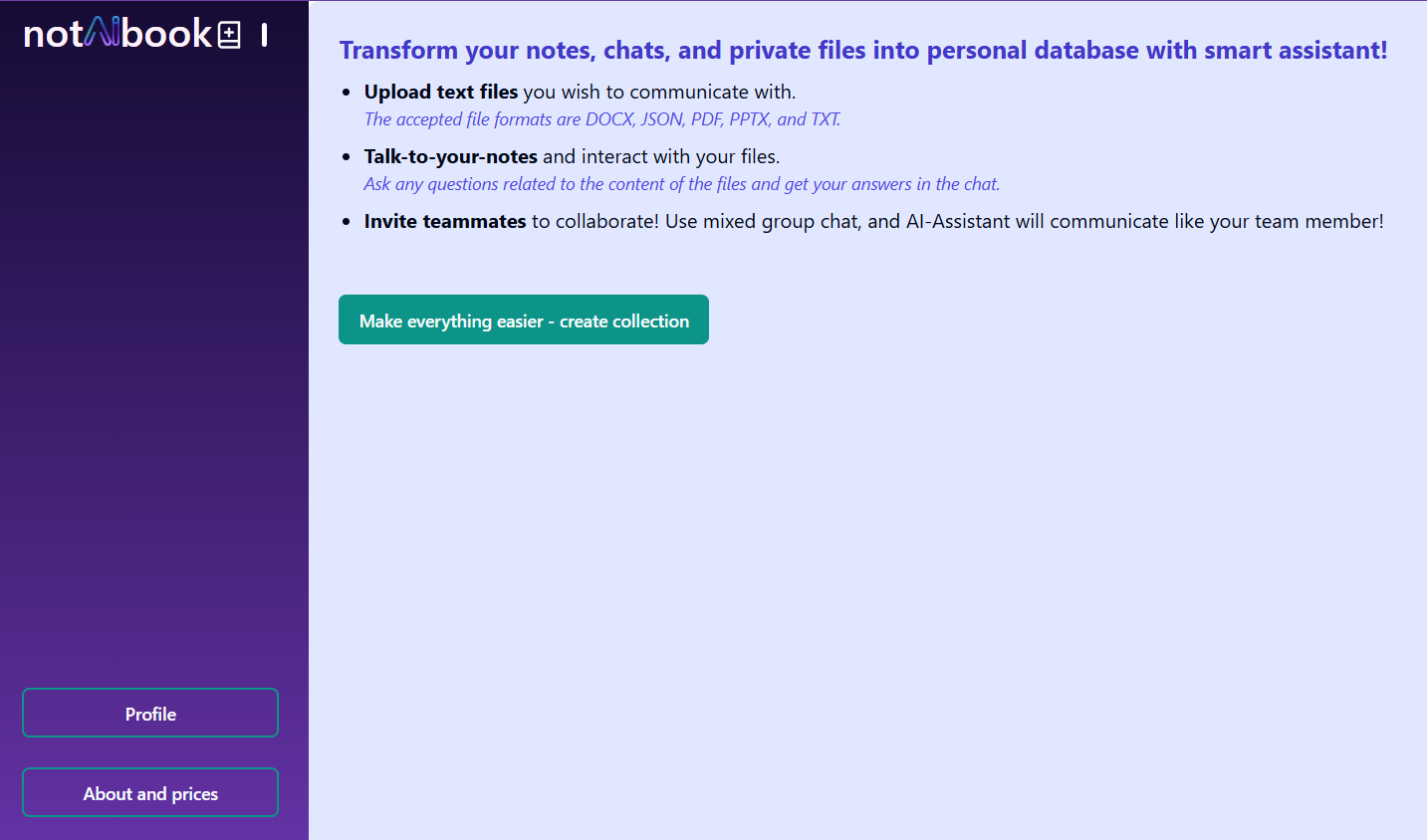
Notaibook is an AI-powered service for creating and organizing notes
notAIbook allows you to upload created Ontologies and see the quality in action. Send us your file or an export of correspondence with the client (with anonymized data, of course) and we will build an Ontology for you using our Ontology Builder. On the notAIbook platform, you can talk to your Ontology, ask it questions as if it were a live expert. Compare the answers from the Ontology with the answers from GPT-CHAT, for example, and see the advantages of the platform. Manage access to knowledge – add friends or colleagues to the Ontology chat and use notAIbook as a common interactive knowledge base!
